

Proteomics and AI identify plasma biomarkers for vasculitis
Vasculitis is a disease whereby the immune system mistakenly attacks blood vessel walls, causing them to become inflamed. If left untreated, the rare disease can severely damage organs, including the kidneys and lungs. Physicians can treat vasculitis with immunosuppressive medications. But since these drugs often cause serious side effects, they have long sought a way to distinguish people in remission to avoid treating these patients unnecessarily, or to minimize treatment regimens.
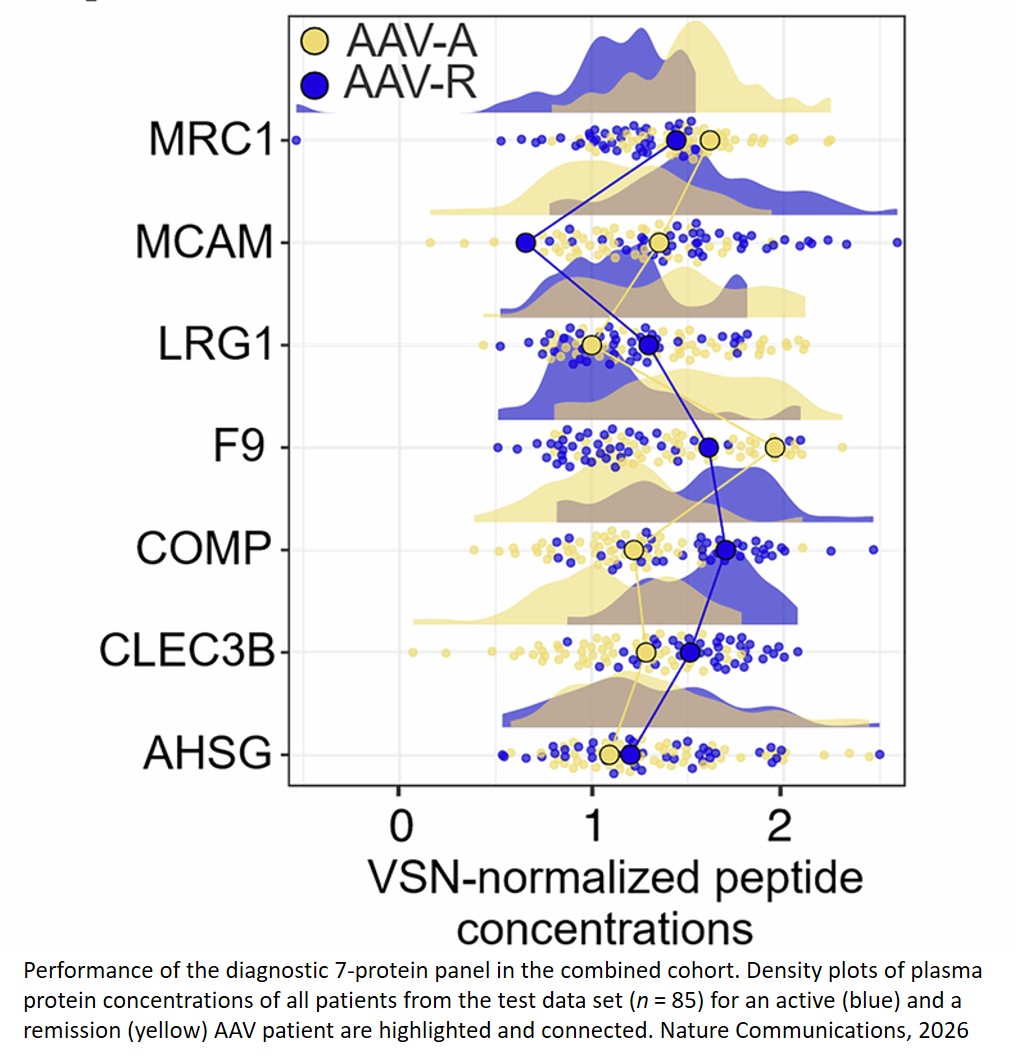
A team of researchers and physicians in Berlin now has found a combination of seven proteins in patients’ blood plasma that reliably indicates whether the disease has gone into remission. In the journal “Nature Communications,” the group reports how proteomics and artificial intelligence helped them identify the biomarkers. In principle, their method could also be applied to other immune and inflammatory diseases to make treatment as precise as possible while minimizing side effects.
“Existing biomarkers, such as the inflammatory marker CRP, cannot reliably tell us whether a patient is in remission,” explains one of the first authors. “For some patients, it takes only three months before we can reduce their medication; for others, it may take six months or longer,” adds the author. Better biomarkers are needed to guide treatment, which is what prompted the team to collaborate with other Berlin researchers.
“We first identified proteins present in blood plasma from more than 100 Charité patients with vasculitis, about half of whom were in remission, as well as from a control group of healthy individuals,” explains a co-first author. They identified several hundred proteins of varying levels depending on disease status.
“My task was then to use machine learning, a form of AI, to find proteins among the hundreds identified that were specific to remission,” says another co-first author. “The key was to first remove from the analysis all the proteins that could mislead the model, like CRP for example, because they weren’t specific enough.” This was a lengthy learning process, the author adds.
After accounting for all potential confounding factors, the researchers found a combination of seven proteins that could reliably identify remission. They confirmed their findings in a separate group of around 100 patients on whom blood plasma samples and clinical data were available.
“Advances in proteomics and AI allow us to develop these kinds of multiprotein signatures,” says the author. “They capture the biology of complex diseases much more comprehensively than individual protein biomarkers can.”
Right now, the causal relationships between the seven proteins and vasculitis remain unclear, the author cautions. “We also don’t have a widely available test yet,” another author adds. The next step is to conduct studies with larger numbers of participants to determine how well the new assay performs in routine clinical practice — and how much patients actually benefit from it.
https://www.nature.com/articles/s41467-026-75755-6
https://sciencemission.com/proteomic-plasma-biomarker-panel